July 30, 2026
In the latest instalment of our exclusive China series, we dig into China's yellow pea imports — the global production picture, this year’s supply pressure points, and what it all means for traders, complete with insider insights from key industry voices.

China consumes around 3.4 MMT of dry peas annually, with domestic production supplying less than half of that demand, making imports a critical part of the market.
China continues to be the world's largest consumer of dry peas, but its domestic output does not typically surpass 1.5 MMT, leaving more than half of their approximately 3.4 MMT of domestic consumption to be supplied by outside markets. In 2026, the two main suppliers remain the same: Russia and Canada, with smaller, supplementary imports from various alternative suppliers such as Ukraine, Kazakhstan, and the US.
Last year saw excellent production of peas around the world, including record totals in Russia, whose 2025 dry pea crop has been estimated as high as 5 MMT. However, the prices for Russian peas were not as strong as expected, according to Sergey Pluzhnikov of Russian Pulses Analytics.
"This year's exports were very difficult. China's domestic prices were falling, which was dragging down the purchase price in Russian ports. I think that in the August-July season, China will be able to reach imports of 2 MMT, of which about 60-65% have been Russian peas”, Pluzhnikov says.
This year, the picture for Russian pea supply may be a little different, he states, despite positive signs for early harvesting. “We can already conclude that the 2026 yields of southern peas in Russia are higher, largely due to Rostov and Krasnodar, where droughts affected yields last year. This year, 3 t/ha is not uncommon. It would be frivolous to say that 3 t/ha is the average result – the data has yet to be collected and processed. At the same time, I would not be surprised if the final result is about 1 MMT lower – last season's prices were demotivating – oilseeds performed better.”
With a reduction of 1 MMT in overall pea production, Russian yellow pea supply may be diminished, depending on the available carry-in.
Pluzhnikov also believes that there is "no serious competition" for exports into China this year outside of Russia and Canada. Despite seeing Ukraine brought up as an alternative crop to negotiate prices, he believes that "most likely, mass certification and monitoring of seeds and fields are still in process" in Ukraine, preventing them from making strides in its total export supply to China.
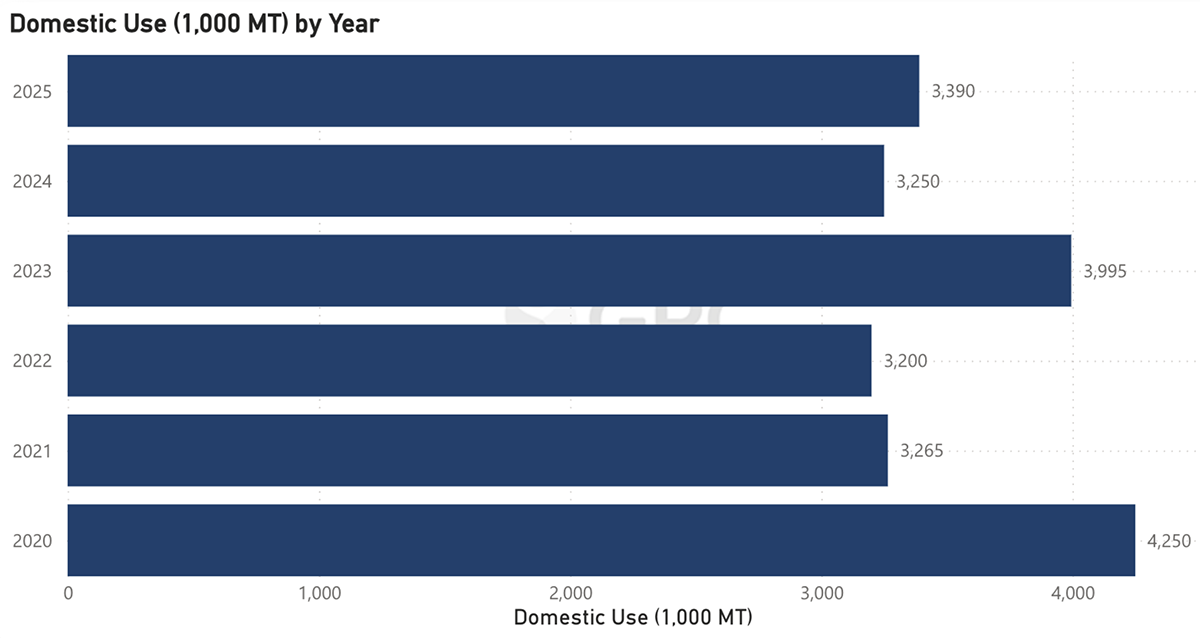
Chinese domestic yellow pea use (KMT) by year. Source: Pulse Atlas.
Canadian peas lost effective access to the Chinese market in March 2025, when Beijing imposed a 100% tariff in retaliation for Canada's tariffs on Chinese EVs, causing a collapse in sales for the rest of that year. That tariff was lifted on March 1, 2026 as part of the broader thaw following Prime Minister Carney's Beijing visit, restoring the trade lane for whole peas, though a separate 73.5% anti-dumping tariff on Canadian pea starch (unrelated to whole peas) has applied since July 1, 2026.
Supply into the new crop year is tightening on the Canadian side despite their improved access: StatCan's June acreage report put 2026 dry pea seeding at 3.03 million acres, down 13.7% from 2025, with carry-in stocks already reduced given last season's export pickup from March 1 onwards.
Marlene Boersch of Mercantile Consulting Venture, writing for Saskatchewan Pulse Growers in early July, estimates roughly 85% of that reduced acreage went into yellow peas specifically, reflecting the improved China outlook, and projects a 2.5 MMT export program for 2026/27, assuming the Canada-China relationship holds. On her balance sheet, that combination of lower acreage and strong exports could pull the yellow pea stock-use ratio down to 14-15%, a tight carry-out that may leave China dependent on a smaller Canadian surplus and continued Russian volumes to cover its imports.
2026/27 will continue to see competition for the Chinese export market, but a reduced overall supply seems likely given the unusually large productions of 2025/26. Marlene Boersch has estimated that the global pea production could be down by approximately 13% year-on-year, which would mean tighter supplies, and prices dependent on Russian/Canadian yields and demand from other key consumers such as India, whose rabi crop later in the year could have an impact on the market, especially if the “super” El Niño has an impact on overall pulse yields in kharif season, or yellow pea yields in the forthcoming rabi season. Both situations could potentially lead to a reduction of yellow pea import tariffs in India – a significant lever on the market.
“The cancellation of duties had a strong impact on Chinese demand, but it is worth noting that China is usually not very active in the second half of the season, so the decrease in volume requests should not be explained solely by the Canadian factor. However, as far as I can see, shipments from Canada are quite active now – China is buying up the missing volumes there.”
“For the 2026/27 crop year, we think that about 85% of the acreage has gone into yellow pea varieties because of the improved export movement into China. Assuming the enhanced commercial relations between Canada and China hold, we expect yellow pea exports to continue doing well in the new crop year.”
“If there is no rain over the next month, then prices of pigeon peas and black matpe will go very heavy, and that will impact desi chana as well as red lentils. If overall prices go high because of the deficit, then I think the government will not touch any pulse duty except for yellow peas, which as of right now is 30%. It's possible they could reduce that to 20%, 10%, or even 0%, considering the market volatility.”

Qingdao Pulses Congress / China yellow pea imports / China dry pea market / yellow pea trade / Russia pea exports / Canada yellow peas / global pulse market.


Disclaimer: The opinions or views expressed in this publication are those of the authors or quoted persons. They do not purport to reflect the opinions or views of the Global Pulse Confederation or its members.